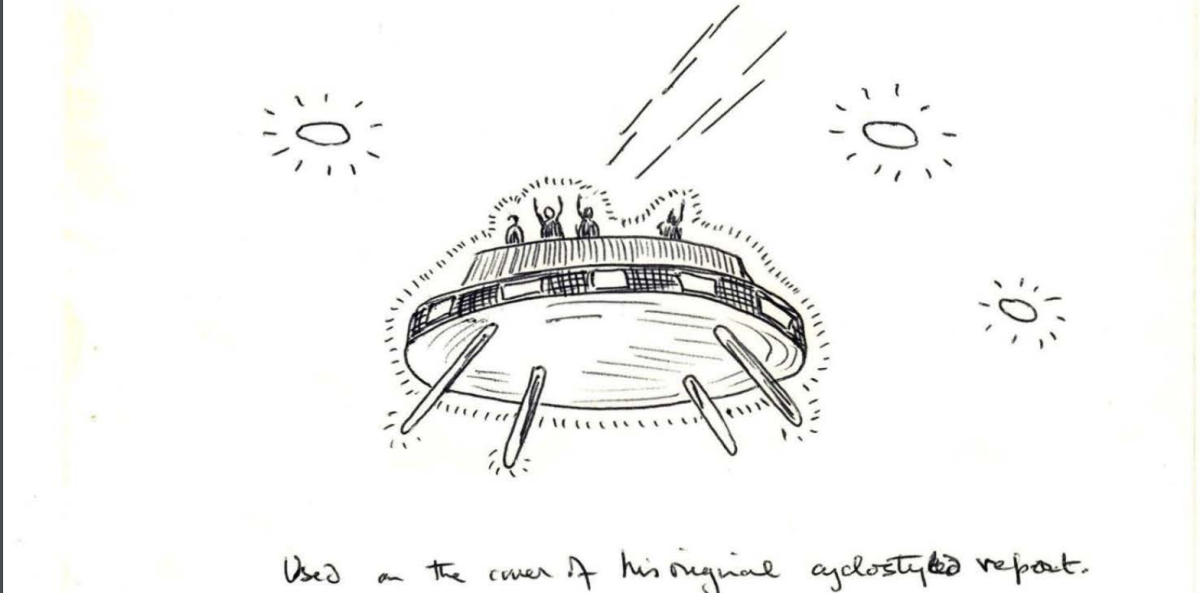
William Gill UFO Drawing
Type: Drawing
Source:
One of the most valuable pieces of evidence from the Boianai incident is William Booth Gill's own hand-drawn sketch of the object. Unlike many UFO illustrations that were created years later by artists, Gill's drawing was made to accompany his written report soon after the sightings and was intended as a factual representation of what he and the other witnesses observed.
What does the drawing show?
Gill's sketch depicts a structured craft with several distinctive features:
A circular lower body, appearing as the main disc.
A smaller upper platform or deck centered on top.
Four landing legs extending downward from the underside.
Four human-like figures standing or moving about on the upper deck.
The figures are drawn outside the enclosed portion of the craft, rather than inside a cockpit.
The object is shown hovering rather than resting on the ground.
Why is it unusual?
The drawing is unusual because it does not resemble the classic 1950s "flying saucer" with a smooth dome.
Instead, Gill portrayed what looks almost like a two-level structure:
a broad circular base,
a smaller elevated platform,
open space where occupants could apparently stand,
and landing supports beneath.
Researchers have noted that this configuration was quite different from the popular UFO imagery of the era.
The figures
Gill stated that he could see four figures moving about on top of the object.
He wrote that they appeared to be:
human in shape,
occupied with some kind of work,
occasionally stopping to look toward the witnesses below.
The drawing places these figures around the perimeter of the upper deck, matching his written description that they seemed to be "doing something" rather than simply standing still.
A working diagram, not artwork
It's important to understand that Gill was not trying to produce an artistic illustration.
His sketch functions more like:
an engineering diagram,
or a witness reconstruction.
The proportions are simple, and there is very little artistic embellishment. His goal appears to have been documenting the layout of the object and the relative positions of the figures as accurately as he could remember them.
Influence on later depictions
Many of the illustrations seen in UFO books and documentaries over the last 60 years are not Gill's original drawing. Instead, they are artists' interpretations based on his sketch and written report.
As a result, later versions often add:
windows,
metallic textures,
lighting effects,
surface details,
or more realistic-looking occupants.
Those features generally do not appear in Gill's own original sketch, which is much more restrained and documentary in nature.
For historians of the case, Gill's original drawing remains valuable because it was created contemporaneously with the events and reflects what he intended to record—not what later artists imagined the craft looked like.
Evidence Files